 EN

Navigating the Demands of Industrial Workwear
When safety managers and purchasing directors outfit teams for rugged outdoor construction, heavy industrial manufacturing, or municipal maintenance, choosing the correct textile is a massive priority. Industrial uniforms must endure physical friction, frequent laundering, and completely unpredictable weather elements without ever sacrificing wearer comfort or mobility. Among the most popular and widely specified textile options in the global B2B apparel market is the classic polyester-cotton blend, commonly referenced in the industry as T/C fabric. A frequent question that surfaces among safety coordinators is whether this popular blended workwear material can actually deliver dependable waterproofing. The short answer is yes, but with essential technical considerations. While raw, untreated poly-cotton is naturally porous and absorbent, applying modern textile engineering and specialized chemical treatments transforms it into a high-performance protective shield capable of repelling heavy rain and moisture.
Understanding the Intrinsic Properties of Poly-Cotton Blends
To fully understand how weather protection functions on blended textiles, one must examine the micro-structure of the material itself. Poly-cotton blends typically combine synthetic polyester fibers—known for high tensile strength, excellent abrasion resistance, and hydrophobic tendencies—with natural cotton fibers, which provide exceptional breathability, softness, and moisture absorption. In a standard poly-cotton weave, the cotton yarns naturally draw in ambient moisture, making untreated workwear susceptible to soaking during prolonged exposure to heavy rain. However, this exact structural composition provides an ideal physical canvas for advanced technical modifications. Because synthetic polyester lacks active dye sites and absorbs very little water, the synthetic backbone of the fabric acts as a stable foundation, allowing textile engineers to anchor weather-resistant treatments securely onto the yarn surface without degrading the overall mechanical strength or tear resistance of the material.
Engineering Water Resistance Through Advanced Finishes
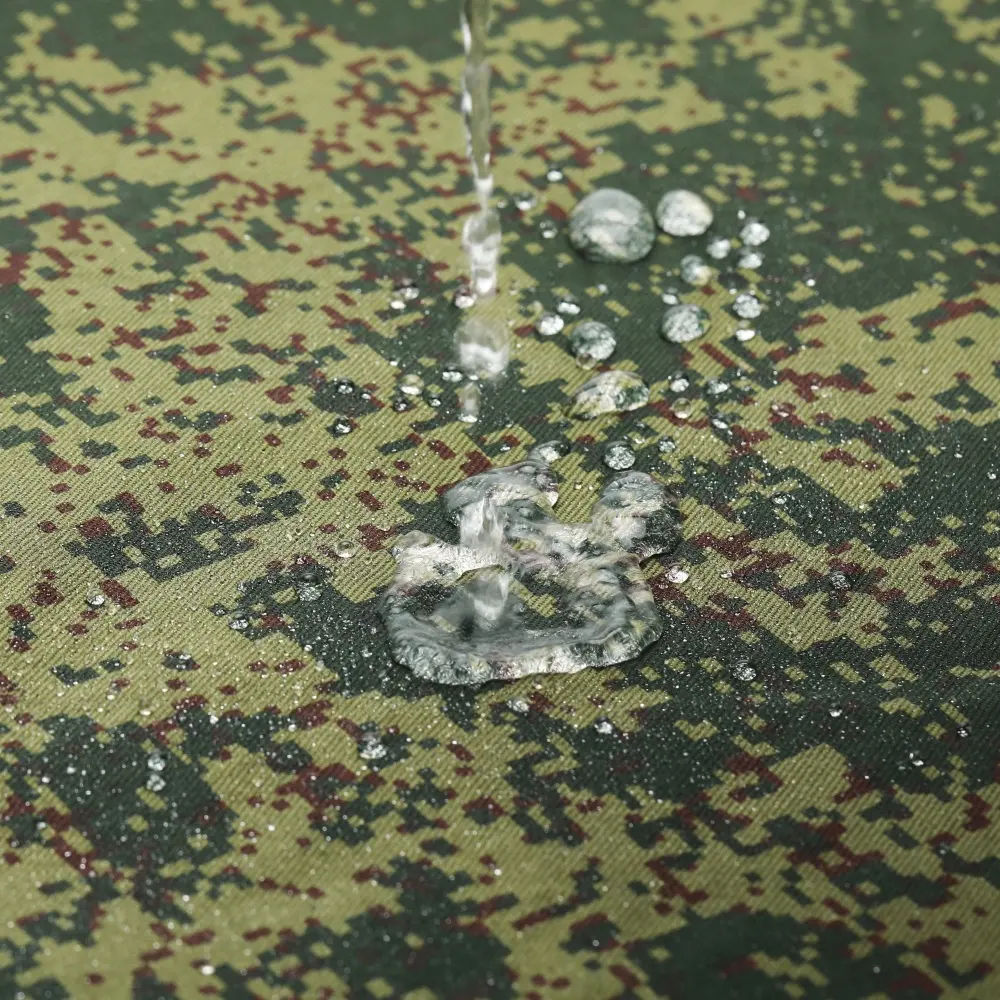
Achieving true water resistance or complete waterproofing on a blended workwear fabric requires sophisticated chemical processing rather than relying solely on a tight weave. Professional fabric suppliers utilize various multi-level interventions, starting with surface-level Durable Water Repellent treatments. These microscopic chemical barriers lower the surface energy of the fabric, causing incoming water droplets to bead up and roll off instantly rather than wetting out the outer face of the material. For more demanding rainy environments, advanced lamination techniques or breathable polyurethane membranes are bonded securely to the reverse side of the poly-cotton fabric. Industry testing metrics, such as hydrostatic head testing and spray evaluations, are regularly utilized to verify that treated poly-cotton fabrics withstand heavy downpours while maintaining strict compliance with international safety and durability benchmarks.
Balancing Weather Protection with Breathability and Comfort
One of the greatest challenges in industrial apparel engineering is preventing the uncomfortable sauna effect—a scenario where rain is successfully kept outside, but internal perspiration becomes trapped, causing physical discomfort and sudden chills. In practical field experience, workers wearing completely impermeable, non-breathable plasticized garments often experience fatigue, overheating, and skin irritation due to trapped heat accumulation. This is where treated polyester-cotton fabrics offer a distinct operational advantage. By utilizing micro-porous finishes or ecological fluorocarbon-free water-repellent treatments, elite manufacturers ensure that while liquid water droplets cannot penetrate the fabric matrix, body heat and vapor can easily escape through microscopic channels. Balancing waterproof ratings with a high breathability index guarantees that industrial teams remain dry, comfortable, and productive during long, physically demanding shifts in humid or wet climates.
Supply Chain Resilience and Partnership Value Through Hebei Gaibo
Sourcing technical workwear fabrics that successfully merge waterproofing, breathability, and mechanical durability requires a manufacturing partner with deep industry expertise and robust production facilities. This is where seasoned textile mills deliver unmatched commercial value to global apparel brands. Backed by extensive experience in industrial textiles, Hebei Gaibo stands at the forefront of advanced fabric engineering. Operating state-of-the-art spinning, weaving, and chemical finishing lines, Hebei Gaibo produces top-tier polyester cotton workwear fabric engineered with precise functional finishes, including customized water-repellent and oil-resistant treatments. By integrating rigorous quality control protocols with massive, reliable output capacities, Hebei Gaibo empowers international workwear brands with consistent quality, dependable lead times, and superior protective performance, making them an ideal strategic partner for your next safety apparel collection.
